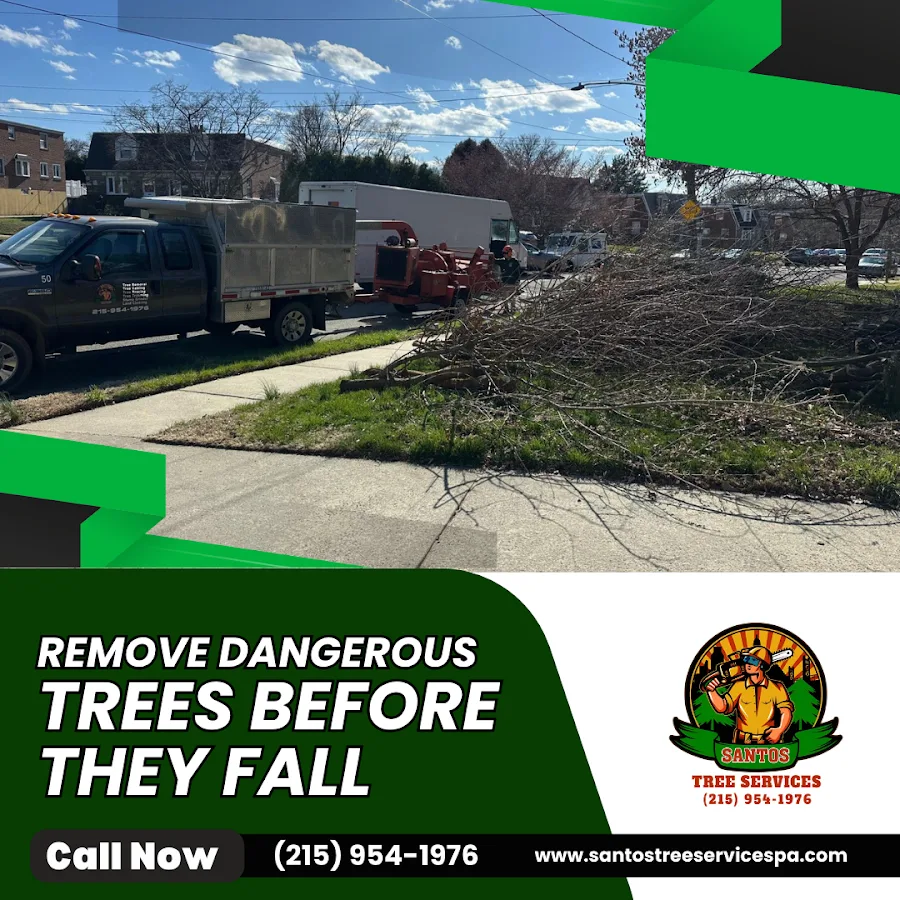
When a tree is damaged, the first question is often whether it must come down. That may be the answer, but a hanging limb, a split trunk, a tree already on the ground, and a stump left from earlier work are different situations. For Philadelphia property owners considering Santos Tree Services, a useful first step is to describe the immediate condition clearly, then confirm which parts of the job the company is being asked to assess.
Describe the hazard before deciding on removal
Keep people away from visibly unstable trees and limbs; do not climb, cut, or attempt to move a tree near a structure or utility line. If there is an immediate danger to people or an active utility hazard, contact the appropriate emergency or utility provider rather than treating a contractor call as the only response. Once the scene is safe to discuss, note what changed, where the damage is, and what it could affect: a roof, driveway, fence, sidewalk, or access route.
Those details help distinguish an urgent obstruction from a damaged tree that may need a closer assessment. Photographs taken from a safe distance can help explain the situation, but they do not replace an on-site evaluation. Avoid assuming that a tree should be removed solely because a large branch has fallen; the decision depends on the tree’s condition and the proposed work.
Match the request to Santos Tree Services’ published scope
Santos Tree Services’ website lists tree removal, emergency services, tree trimming, pruning, and stump grinding among its tree-care offerings. Those categories provide a starting point, not a complete project specification. A request for emergency tree removal may involve stabilizing or removing a damaged tree, while trimming or pruning may address selected branches. Stump grinding is a separate scope to discuss if a tree is removed or a stump remains.
Describe the outcome needed rather than relying only on a service label. For example, say whether the priority is to clear a blocked area, remove a particular tree, address damaged limbs, or deal with an existing stump. Then ask what work is included, what is excluded, and whether the contractor recommends a different scope after inspecting the site. The company website also lists “Certified Arborists”; customers can confirm who would assess the tree and what credentials apply to the person assigned to the project.
Separate tree work, debris, and stump decisions
Removal, haul-away, and final cleanup should not be treated as interchangeable. Ask whether the proposed work includes cutting and removing the tree, hauling branches and logs, clearing the work area, and handling a stump. If stump grinding is wanted, clarify whether it is included in the same proposal or considered separately, and what the result will look like afterward. The website’s listing of stump grinding confirms it as a published service, but does not establish the exact terms for an individual job.
Property details can change what needs to be discussed. Point out fences, sheds, planting beds, narrow access, overhead obstructions, and the location of nearby structures. Do not assume a particular removal method or machine will be used; ask how the crew expects to access the tree and protect the areas that matter. A clear scope makes it easier to compare proposals on the same basis.
Use Philadelphia location details to make the inquiry specific
The listed business address is 7010 Kindred St, Philadelphia, PA 19149, United States. When contacting Santos Tree Services, give the property’s location separately from the company address and explain access constraints, parking limitations, or whether the work area is behind a building. Ask whether the company serves that particular property and what information it needs to assess the request; a Philadelphia listing alone does not establish availability for every job or timing.
The company’s official website is santostreeservicespa.com, and the listed phone number is +1 215-954-1976. The website presents emergency tree services and shows operating hours as Monday through Saturday, 7 a.m. to 5 p.m. Because published hours and emergency-service descriptions do not guarantee a response at a particular time, confirm current availability directly, especially after a storm.
Get the important project terms in writing
Before work begins, request a written description of the agreed tasks, debris handling, stump work if applicable, expected timing, price, and any exclusions. Ask who is responsible for obtaining any required permissions or coordinating around utilities, rather than assuming those arrangements are included. Owners can also ask what documentation they should review before work starts. The website mentions safety protocols, but the specific plan and project terms should be confirmed for the property in question.
These checks are useful whether the request concerns storm damage, planned removal, or maintenance. They keep the conversation focused on the tree’s condition, the exact work, and the property’s constraints instead of an unclear label such as “emergency service.”
A focused call can resolve the next decision
For a first conversation with Santos Tree Services, describe what happened, identify immediate risks without approaching them, give the job address, and state the outcome you are seeking. Then confirm assessment availability, the proposed scope, cleanup and stump details, and the terms that will appear in writing. That approach does not predetermine whether a tree should be removed; it gives the property owner a clearer basis for deciding what to authorize next.