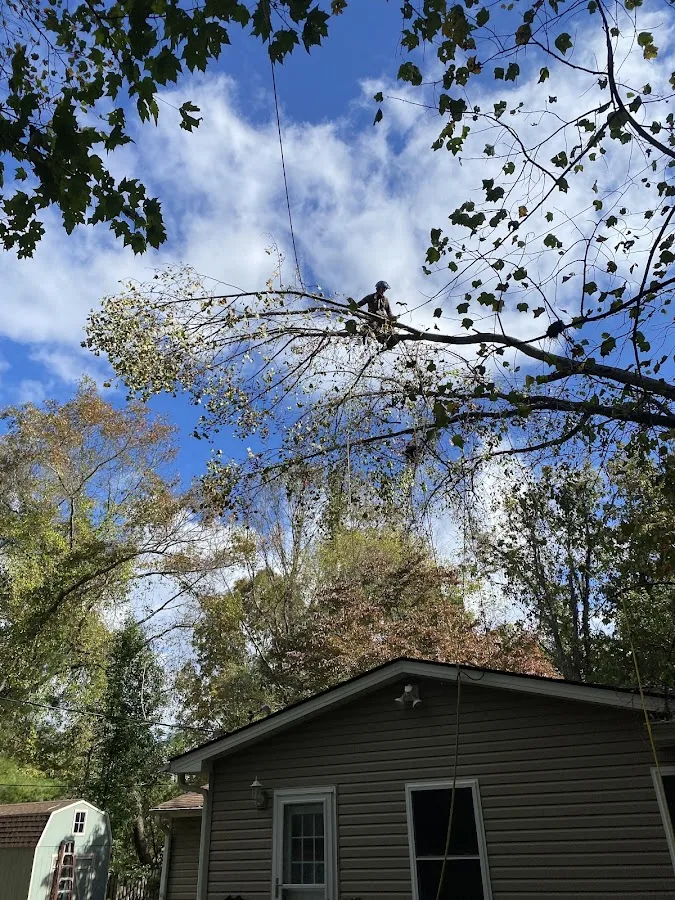
Usually, no. Tree topping can make a crown look shorter at once, but it does so by cutting major stems or branches back to stubs or to branches too small to take over as leaders. Those cuts change the tree’s structure and can create recurring maintenance rather than a lasting, well-shaped reduction. If a tree is too tall or wide for a particular space, the useful question is whether selected branches can be shortened to appropriate laterals while preserving the crown.
What topping means—and what it does not
Topping is defined by the cuts, not simply by how much shorter a tree looks afterward. A crew may remove height through selective reduction cuts, or it may indiscriminately shorten large limbs and stems. The first approach follows suitable branches; the second leaves blunt ends or redirects growth to undersized offshoots. Looking at the finished silhouette alone may not reveal which method was used, so focus on the locations and scale of the cuts.
For example, imagine a branch extending over a roof. Shortening it back to a substantial lateral branch that can continue its growth is different from cutting it midway and leaving a stub. In the first case, the cut is tied to a branch that can assume the direction of growth; in the second, the end of the limb has been removed without that structural transition. A smaller-looking canopy is not, by itself, evidence of a sound reduction.
Why a quick height cut can create long-term costs
Large cuts leave larger wounds than cuts made on smaller branches. Trees do not repair damaged wood in the way people heal a cut; they form new tissue around the wound and may isolate damaged areas internally. The larger the wound, the more difficult it can be for the tree to close over it, and exposed wood may become vulnerable to decay. This is one reason removing major portions of a crown can have consequences beyond appearance.
Topped trees often produce vigorous shoots near the cut ends. These shoots can quickly restore some leafy cover, which may make the tree seem to be recovering its former shape. But rapid growth does not recreate the original branch architecture. Several shoots may emerge from the same area, creating a crowded cluster rather than a single well-positioned continuation. As they grow, the new outline can become dense and uneven, and the tree may need further pruning to manage it.
That pattern changes the cost calculation: a dramatic one-time reduction may lead to repeated work, while the tree still retains the structural effects of the original cuts. If the goal is to keep a tree within a particular clearance or away from a defined area, consider whether managing a few selected branches can address that need without removing large sections of the crown.
What targeted reduction looks like
Reduction pruning shortens selected branches by cutting them back to suitable lateral branches. The remaining lateral should be positioned and sized to continue the branch’s growth; the aim is a more controlled transition, not a row of shortened ends. When planned across a crown, these cuts can preserve a more natural outline than indiscriminately cutting large stems. The result depends on the tree’s existing structure and the specific branches available for reduction.
The intended outcome matters. Reducing the reach of one limb is not the same job as lowering the entire crown. A branch that conflicts with a roofline may have a usable lateral in the right direction, while the top of a tree may not offer suitable branches that allow a substantial height change. In that case, a responsible plan may be limited to a modest reduction or may conclude that pruning cannot deliver the requested shorter profile without compromising the tree’s form.
How to evaluate a proposed height reduction
Before work begins, ask the tree-care provider to describe the intended cuts rather than relying on a broad promise to “make it shorter.” A clear explanation should connect the tree’s problem to particular branches and show where each reduction cut would end. That lets you compare the proposed work with the principles above instead of judging only the desired final height.
- Identify the goal: Is the concern one branch’s reach, clearance in a particular area, or the overall crown height?
- Locate the cuts: Which branches will be shortened, and what suitable lateral branch will remain at each cut?
- Discuss the likely form: How will the selected cuts change the crown’s outline, and what kind of regrowth should be expected?
- Test whether the result is realistic: Can the tree meet the requested height or spread while retaining appropriate structure, or does the plan need a narrower goal?
A plan described only as removing the top or cutting everything back does not tell you how the tree’s structure will be preserved. Columbia readers can find local tree-service information for Expert Tree Care LLC.
The practical standard is not simply “shorter.” It is whether the specific cuts solve the space or clearance problem while leaving suitable branches to carry the crown forward. If the proposal cannot explain that connection, it has not yet explained why topping is the right method.